The Synthetic Flood: Why Automation Fails Brand Craft
We are in a time where generative AI models can give you ten logo variations in thirty seconds, and the temptation to automate away your creative identity has never been higher. The owners very frequently assume that through great prompting and an SVG export, that a good logo can be had. That is true in theory, but in practice it usually plays out much differently. We often see people who use AI for logo or flyers or anything struggle to get it from digital to physical. When you go to embroider shirts or print flyers, or anything of that nature, oftentimes you'll get hit with massive printing bills because AI loves to get intricate and detailed in its creations and use lots of color, whereas a simple flyer would have done the job fine. Or other times the layers in the generated file aren't true layers, but one big blob that printers have a difficult time printing with. It turns a seemingly easy task into a logistical nightmare. Not to mention that most humans have very quickly caught on to the ones who build their flyers and logos (or have them built) and the ones who just generative AI everything. That's why we draw every mark by hand, because trust that lasts is earned through craft and human interaction, not statistical probability.
You've found an entry in our Branding Notes series. Consider this our studio scratchpad: raw thoughts on brand identity, creative direction, and visual craft. It's not a showroom of our studio's visual standards—it's just honest talk. For our finished craft, case studies, and client work: Step Inside Spraycan Creative
1. Off the Rip: Our Zero-Generative Art Principle
Our studio's stance on anything commercial design has not changed since the day we were founded. From the beginning we refused to use AI for anything that was generative. So even though it can take longer than a 30-second prompt, we choose to make and design every spec by hand with intentionality and authenticity. Of course we do not reject modern technology though, it just means we know its boundaries for our work. We view artificial intelligence through the classic hammer analogy lens: a hammer is an exceptional tool for building up a house and many other things, but that same hammer can also be used to commit all sorts of crimes as well. The instrument is the natural part, the merit of it lies entirely in how you swing that hammer. So we actively use AI for technical leverage, such as auditing complex website scripts, stress-testing SEO metadata, verifying sitemap hygiene, and even finding trends and patterns in web traffic numbers and what sells best when. But when it comes to the artistic heartbeat of a business, we refuse to compromise on our work and our craft at the benefit of speed and convenience. A mark is the first thing people see about your business other than the name, so we know businesses had better make it count. As creative director, Patrick's rule in our studio is simple: 'the bad use for AI is using it to create your brand or anything that is forward-facing artistically that would be representational of your brand or your business.' (See our detailed studio position in our thoughts on AI in art).
2. Human Hands on the National Stage: Collegiate Athletic Systems
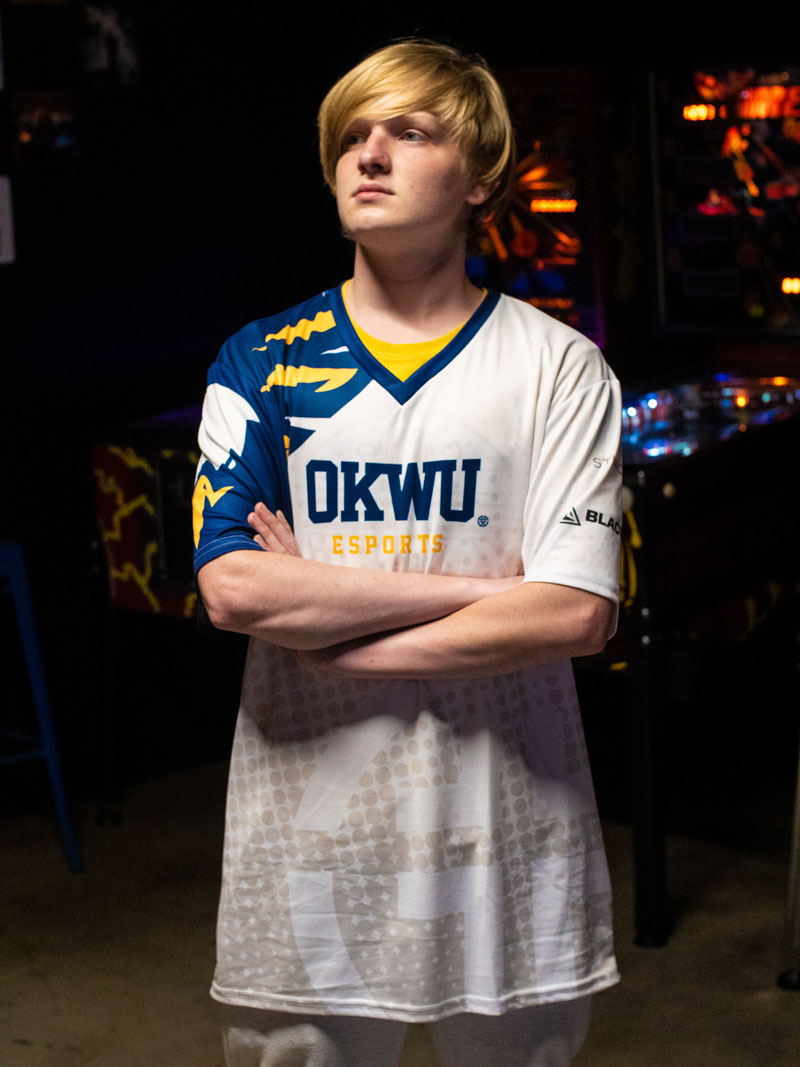
Because our studio is based in Yukon, Oklahoma, people sometimes ask whether handcrafted identity systems can compete nationally against coast-to-coast mega-agencies. The proof lives directly on university athletic courts. Through the Fatcap athletic apparel brand, Patrick has served as creative art director designing custom collegiate jerseys and esports uniforms for universities nationwide—including Northern Michigan University, Oklahoma Wesleyan University, and Redlands Community College.
Collegiate uniforms require ruthless vector discipline: sub-millimeter stitching paths, custom jersey typography, and subculture-specific weight that no AI prompt can engineer. When athletes take the court wearing tailored hand-drawn typography, nobody cares what state the designer was sitting in. They just recognize elite craft. As Patrick puts it: “Working with so many universities across the country shows our craft is national.”
True identity design is not about regional geography—it is about the willingness to put in the hours, study the subculture, and refuse lazy digital shortcuts. Whether designing high-performance athletic systems for national universities or hand-drawing an overland cryptid in rural Oklahoma, authentic craft commands respect anywhere people care about real identity.